



Ninety-five percent of enterprise AI pilots never reach production. The problem is not the technology. It is that most organizations confuse automation with intelligence, and skip the structural work that makes the transition possible.
The Wrong Assumption : More Automation Equals More Intelligence
Every enterprise has an automation story. Robotic Process Automation (RPA) bots handling invoice processing. Workflow engines routing approvals. Scheduled reports running overnight. These are real wins. They reduced manual effort, cut error rates, and freed people from repetitive work.
But here is the assumption that gets organizations stuck: if we automate enough processes, we will eventually have an intelligent enterprise.
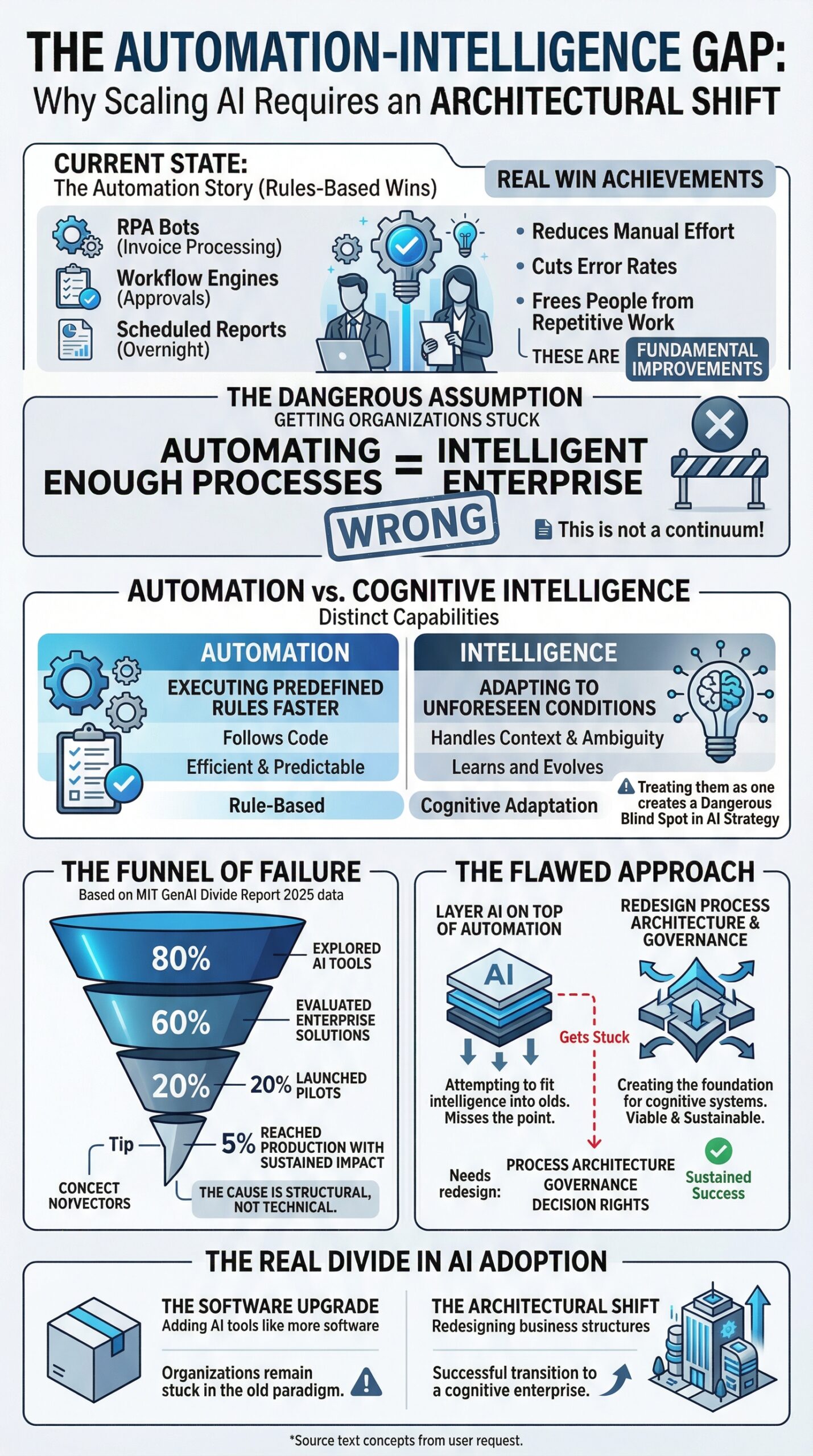
This is wrong. Automation executes predefined rules faster. Intelligence adapts to conditions that rules cannot anticipate. These are fundamentally different capabilities, and treating them as a continuum creates a dangerous blind spot in your AI strategy.
MIT’s GenAI Divide: State of AI in Business 2025 report quantified this gap. Approximately 80 percent of organizations have explored AI tools. Roughly 60 percent evaluated enterprise-level solutions. Only 20 percent launched pilots. And a mere 5 percent reached production with sustained, measurable business impact. The funnel of failure is steep, and the primary cause is not technical. It is structural. Organizations attempt to layer intelligence on top of automation without redesigning the process architecture, governance, or decision rights that make cognitive systems viable.
The real divide is not between companies that adopt AI and those that do not. It is between those that understand the transition from automation to cognitive systems as an architectural shift, and those that treat it as a software upgrade.
Three Stages, Three Different Architectures
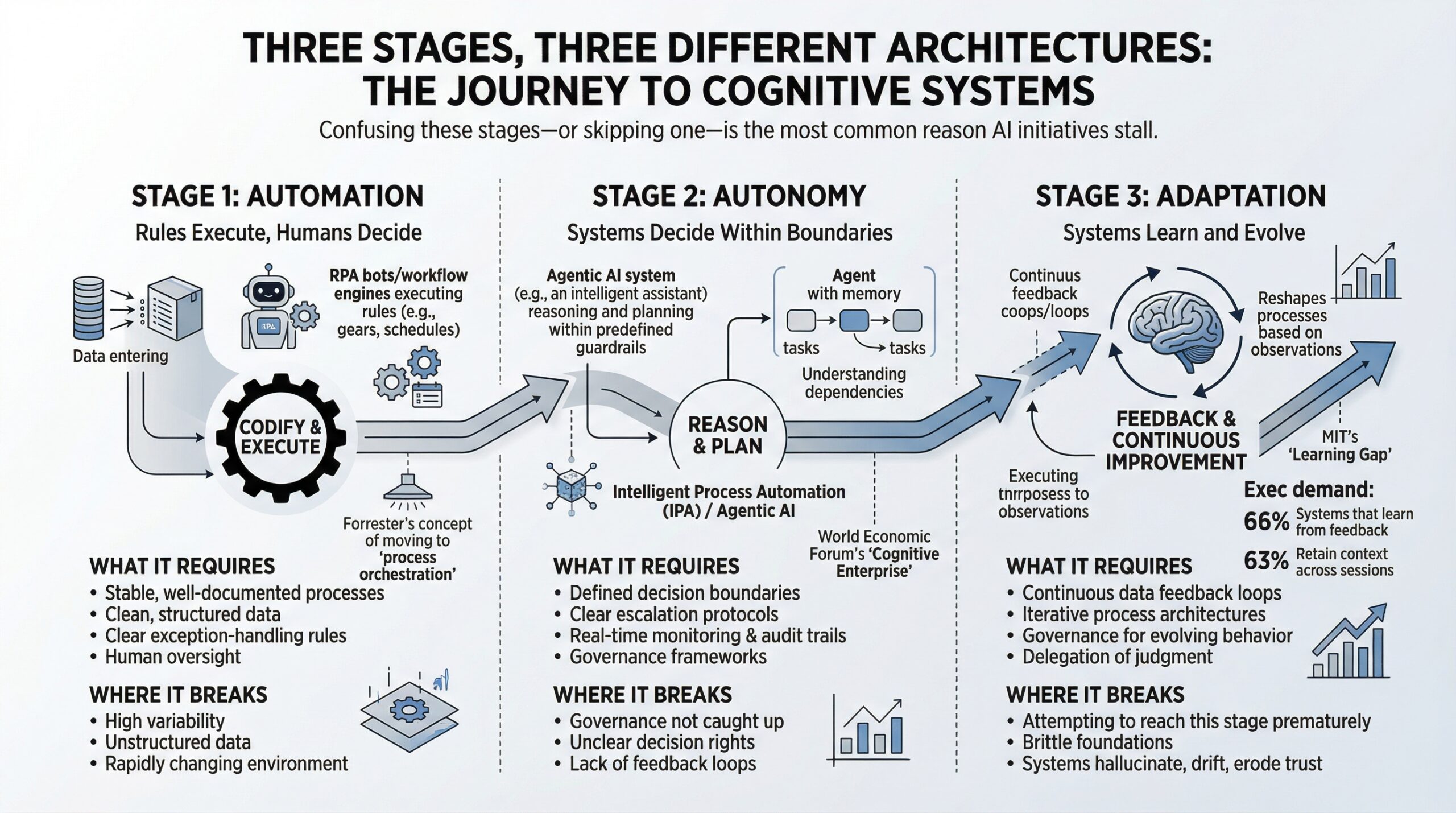
The journey from automation to cognitive systems is not a smooth ramp. It moves through three distinct stages, each requiring different process architectures, governance structures, and organizational capabilities. Confusing these stages, or skipping one, is the most common reason AI initiatives stall.
Stage 1: Automation – Rules Execute, Humans Decide
Automation is where most organizations live today. The operating principle is straightforward: codify a human decision into a rule, and let software execute it at scale. RPA bots, workflow engines, and scheduled batch processes all operate here. The value is speed, consistency, and cost reduction in high-volume, low-variability tasks.
What it requires: Stable, well-documented processes. Clean, structured data. Clear exception-handling rules. Human oversight at decision boundaries.
Where it breaks: When processes encounter variability that exceeds the rule set. When unstructured data enters the workflow. When the environment changes faster than rules can be updated. Analyst firm Forrester describes this ceiling as the point where organizations need to move from scripted automation to what they call “process orchestration”, systems that handle ambiguity, not just repetition.
Stage 2: Autonomy – Systems Decide Within Boundaries
Autonomy introduces a fundamental shift: the system makes decisions, not just executes them. Agentic AI systems can independently reason, plan, execute, evaluate, and adjust, within guardrails set by humans. They maintain memory across tasks, understand dependencies, and re-route when a step fails.
This is the territory of Intelligent Process Automation (IPA) and agentic AI. The World Economic Forum describes this as the beginning of the “cognitive enterprise”, organizations that move beyond automation to drive adaptive actions across strategy and execution.
What it requires: Defined decision boundaries. Clear escalation protocols. Real-time monitoring and audit trails. Governance frameworks that specify who approves what, and under what conditions the system’s autonomy should be overridden.
Where it breaks: When governance has not caught up with the system’s capability. When decision rights are unclear. When the organization lacks the feedback loops to evaluate whether autonomous decisions are producing the intended outcomes.
Stage 3: Adaptation – Systems Learn and Evolve
Adaptation is where cognitive systems operate. These are not just autonomous; they learn. They retain feedback, adapt to context, and improve over time. The system does not just follow a process; it reshapes the process based on what it observes.
MIT’s research identifies this “learning gap” as the core barrier to enterprise AI scaling. Most GenAI systems do not retain feedback, adapt to context, or improve over time. The executives surveyed were explicit about what they need: 66 percent demand systems that learn from feedback, and 63 percent require systems that retain context across sessions.
What it requires: Continuous data feedback loops. Process architectures designed for iteration, not just execution. Governance that accommodates evolving system behavior. Organizational readiness to delegate judgment, not just tasks, to machines.
Where it breaks: When organizations attempt to reach this stage without mastering Stage 1 and Stage 2. Cognitive systems built on brittle process foundations and unclear governance do not adapt. They hallucinate, drift, and erode trust.
The Three-Stage Transition at a Glance
| Dimension | Automation | Autonomy | Adaptation |
| Core Action | Execute rules | Decide within guardrails | Learn and evolve |
| Data Requirement | Structured, clean | Structured + unstructured | Continuous feedback loops |
| Human Role | Define rules, handle exceptions | Set boundaries, monitor | Govern, audit, intervene |
| Governance Need | Exception handling | Decision rights, escalation | Adaptive policy, drift monitoring |
| Risk Profile | Low (predictable) | Medium (bounded decisions) | High (emergent behavior) |
| Failure Mode | Breaks on variability | Breaks on unclear governance | Breaks on weak foundations |
The Decision : When to Transition
The question is not whether to move from automation to cognitive systems. It is whether your organization is ready for the transition, and whether the process you are targeting actually requires it.
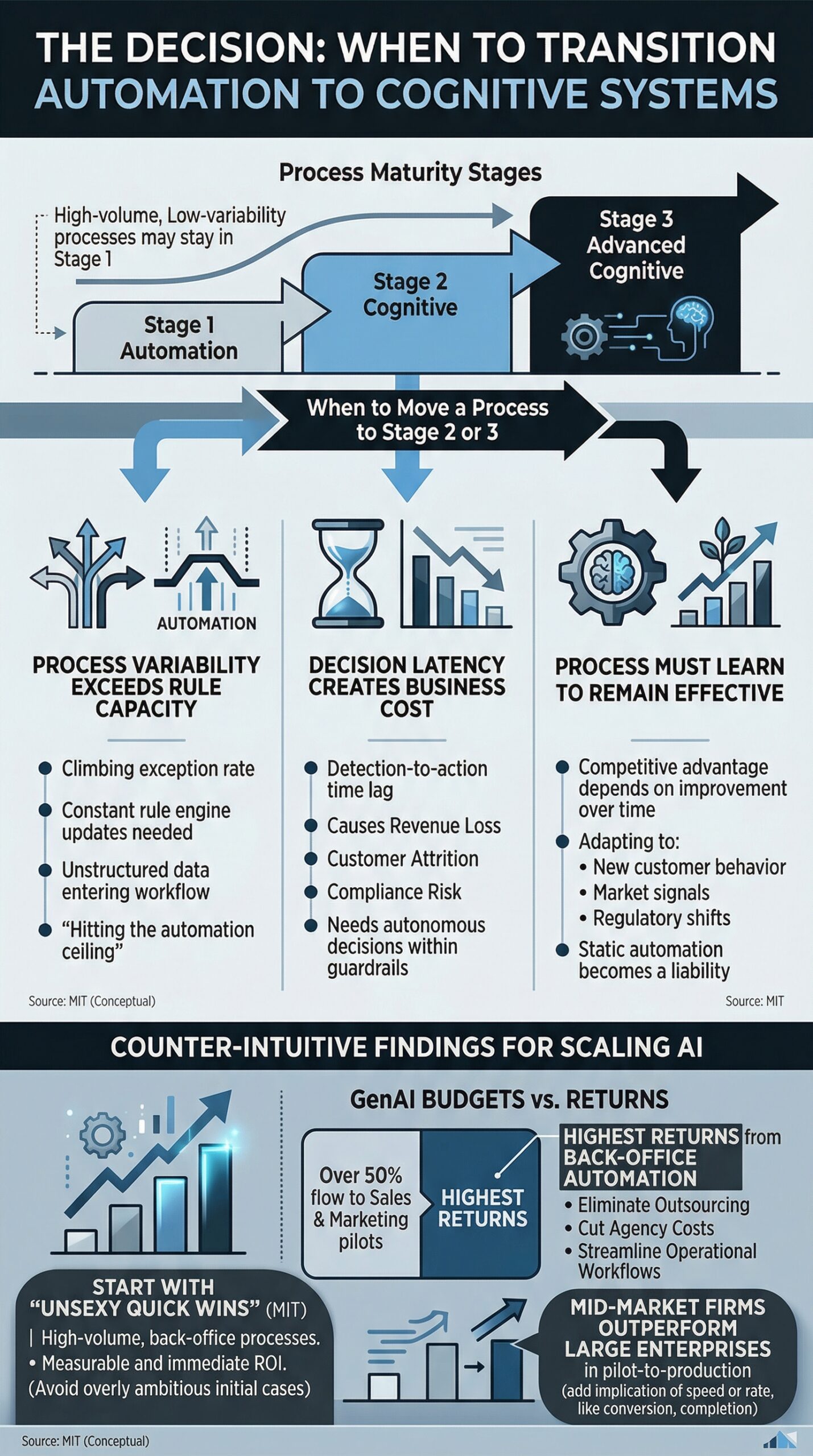
Not every process needs cognitive capability. High-volume, low-variability processes may deliver optimal value at Stage 1 indefinitely. The decision to move a process to Stage 2 or Stage 3 should be driven by three conditions:
- Process variability exceeds rule capacity. If your exception rate is climbing, if the rules engine needs constant updating, or if unstructured data is entering the workflow, you are hitting the automation ceiling.
- Decision latency creates business cost. If the time between detecting a condition and acting on it is causing revenue loss, customer attrition, or compliance risk, autonomous decision-making within guardrails can close the gap.
- The process must learn to remain effective. If your competitive advantage depends on the process improving over time, adapting to new customer behavior, market signals, or regulatory shifts, then static automation will eventually become a liability.
The data support a counterintuitive finding: the organizations that scale AI most effectively do not start with the most ambitious use cases. They start with what MIT calls “unsexy quick wins”, high-volume, back-office processes where ROI is measurable and immediate. Over half of GenAI budgets today flow to sales and marketing pilots, yet the highest returns come from back-office automation: eliminating outsourcing, cutting agency costs, and streamlining operational workflows.
Mid-market firms outperform large enterprises in pilot-to-production conversion. Top mid-market performers report timelines of 90 days from pilot to full implementation, compared to nine months or more for large enterprises. Speed comes from focus, not scale.
The Structural Prerequisites Most Organizations Skip
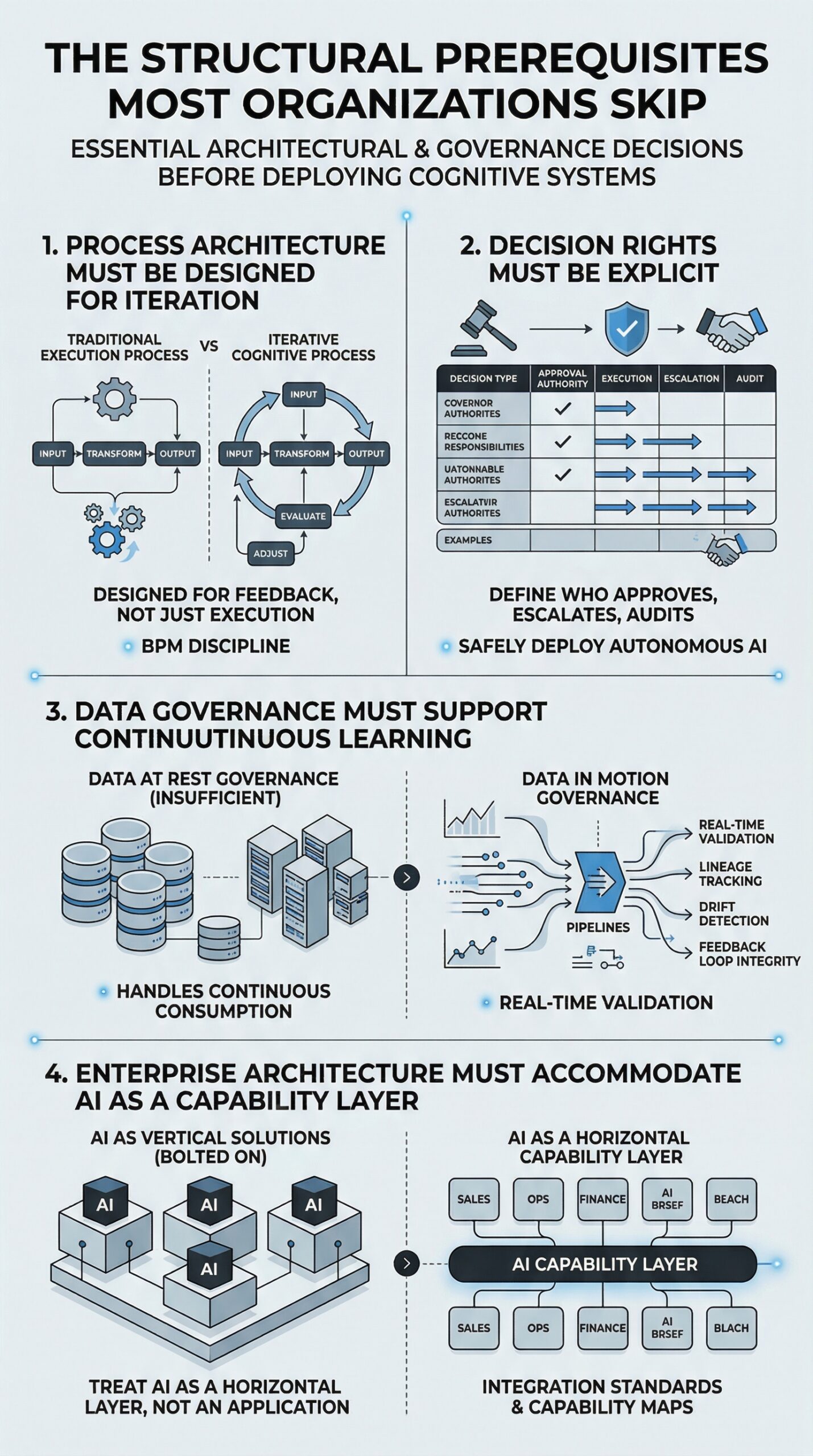
Before any organization transitions from automation to cognitive systems, four structural prerequisites must be in place. These are not technical requirements. They are architectural and governance decisions that determine whether AI systems can operate with autonomy and learn over time.
1. Process Architecture Must Be Designed for Iteration
Most enterprise processes are designed for execution: input, transform, output. Cognitive systems require processes designed for feedback: input, transform, output, evaluate, and adjust. If your process architecture does not include evaluation and adjustment loops, no amount of AI will make it adaptive. This is a Business Process Management (BPM) discipline issue, not a technology issue.
2. Decision Rights Must Be Explicit
Autonomous systems make decisions. If your organization has not defined who approves what, who escalates when, and who audits outcomes, you cannot safely deploy autonomous AI. A decision rights matrix, specifying approval, execution, and audit responsibilities, is a prerequisite, not an afterthought.
3. Data Governance Must Support Continuous Learning
Cognitive systems consume data continuously, not in batches. If your data governance framework only covers data quality at rest (warehouses, reports), it is insufficient. You need governance over data in motion: real-time validation, lineage tracking, drift detection, and feedback loop integrity.
4. Enterprise Architecture Must Accommodate AI as a Capability Layer
AI is not an application. It is a capability that cuts across applications, processes, and business functions. Your Enterprise Architecture (EA) must treat AI as a horizontal layer, with integration standards, capability maps, and clear interfaces, not as a vertical solution bolted onto individual departments.
The cognitive and AI systems market is projected to expand from roughly $100 billion in 2024 to over $700 billion by 2029. This is not speculative spending. It reflects an industry-wide structural shift toward systems that learn, adapt, and operate with increasing autonomy. The organizations that capture value from this shift are those that invest in architecture and governance before they invest in models.
One Practical Move: The Automation-to-Intelligence Audit
Before your next AI investment decision, run a 60-minute audit with your leadership team. The goal is to classify your top processes against the three-stage model and identify which ones are ready for transition, and which need architectural work first.
The Audit
- List your top 10 automated processes by volume and cost. Include exception rates and human intervention frequency.
- Score each process on three criteria: variability (how often rules fail), latency cost (what delays cost in revenue or risk), and learning potential (whether the process must improve to stay competitive).
- Classify each process: Stage 1 (optimize automation), Stage 2 (ready for autonomous decision-making), or Stage 3 (requires adaptive, learning systems).
- For any process classified at Stage 2 or 3, check the four prerequisites: iterative process design, explicit decision rights, continuous data governance, and EA capability mapping.
- Prioritize based on gap size and business impact. Start with the process that has the highest readiness and the most measurable ROI, not the most ambitious use case.
This audit takes less than an hour. It will tell you more about your organization’s AI readiness than any vendor demo or maturity assessment. The organizations that cross the divide between pilot and production do not start with the most advanced technology. They start with the clearest understanding of where they are.
The Bottom Line
Automation gave your organization speed. Autonomy can give it judgment. Adaptation can give it learning. But each transition requires architectural readiness, not just technological capability.
The 95 percent of AI pilots that fail do not fail because the technology is inadequate. They fail because organizations skip stages, ignore governance, and treat intelligence as a feature they can purchase rather than a capability they must build.
The transition from automation to cognitive systems is not a technology project. It is an enterprise transformation. And like every transformation, it starts with an honest diagnosis of where you actually are.
WHAT’S NEXT
Every week, Value Officer breaks down one research insight into a decision your leadership team can act on. Subscribe at valueofficer.com.